Office Cleaning Service for Medical Offices: Questions
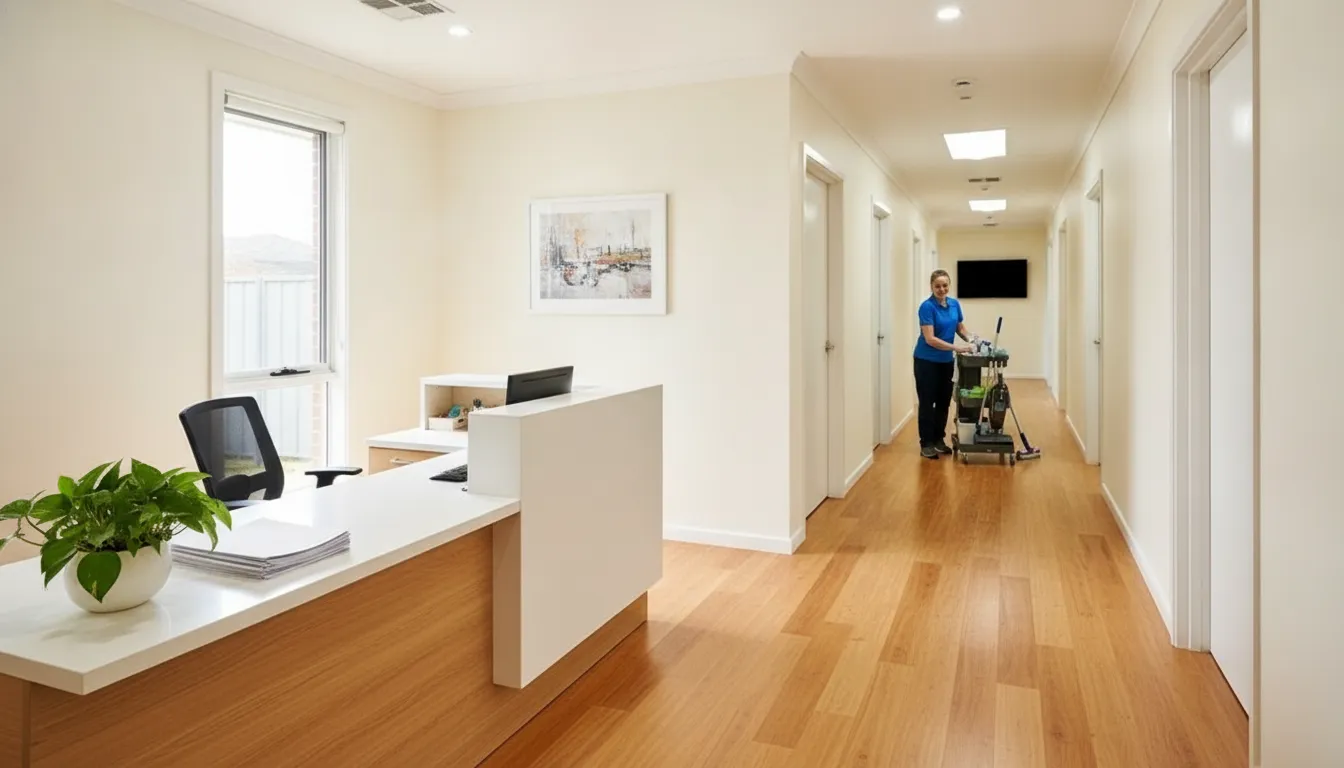
In a medical office, a missed detail can affect more than appearance. Patients, staff, sensitive work areas, and daily schedules all make the cleaning relationship worth evaluating carefully before you sign a contract.
The right office cleaning service for medical offices should answer clear questions about scope, scheduling, access, products, insurance, quality checks, and how concerns are handled. You should also verify any healthcare-specific training, disinfection procedures, or waste-handling capabilities instead of assuming ordinary commercial cleaning covers them.
Start by separating the routine services your office needs, such as office, floor, and restroom cleaning, from requirements that need specialized confirmation. That distinction makes vendor conversations more useful and helps you compare promises with documented procedures.
Contact Maid OK about commercial cleaning services.
Why Medical Offices Need More Than a Generic Cleaning Checklist
A medical practice has many of the same day-to-day cleaning needs as any professional office, including clean floors, restrooms, shared surfaces, and orderly work areas. The difference is that patients, staff, and visitors may move through the space with different needs, and some rooms or procedures may require capabilities beyond ordinary commercial cleaning. A checklist can help you define the basics, but it should not be treated as proof that a provider can handle every healthcare-related requirement.
Start by separating the routine scope from the specialty questions. Routine commercial cleaning may include scheduled office service, floor maintenance, restroom cleaning, and janitorial tasks. Ask how often each area is serviced, which touchpoints are included, what products are used, and how the provider documents completed work. Also clarify whether the team can work around patient appointments and protect private areas during service.
Know where specialty requirements begin
Some practices may need procedures related to infection control, clinical disinfection, regulated materials, or other facility-specific concerns. Those needs should be identified by the practice and verified directly with qualified vendors or relevant professional guidance. Do not assume that a company offering general office cleaning has medical-office credentials, specialized training, or the right procedures for clinical areas. Ask for the exact capability, current documentation, and limits of the service before including it in your agreement.
This distinction also makes vendor conversations clearer. A provider can explain its normal commercial scope without overstating what it does in a healthcare setting. Maid OK offers scheduled office cleaning with frequencies customized to business needs, along with commercial floor and restroom services. Practices considering commercial janitorial services should still describe their facility and ask which requested tasks fall within the provider's verified scope.
The best hiring conversation covers more than whether someone can wipe surfaces after hours. Discuss access, team consistency, insurance, product information, quality checks, communication, and what happens when a task is missed or a room's needs change. That careful review helps a practice choose a cleaning arrangement that supports a dependable workplace without confusing general office care with specialized healthcare services.
What Should an Office Cleaning Service for Medical Offices Include?
A useful scope should describe the everyday work that keeps a practice orderly, comfortable, and ready for the next business day. Ask the provider to walk through each area rather than offering a vague promise to clean the office. The proposal should identify which rooms are included, how often they are serviced, and what the team will do in each space.
Rooms, surfaces, and shared touchpoints
For general office areas, the scope may include reception spaces, waiting rooms, hallways, private offices, consultation rooms, and staff areas. Typical tasks can include removing waste that the provider is approved to handle, dusting accessible surfaces, vacuuming or mopping floors, and cleaning interior glass or other agreed surfaces. Ask whether high-touch points such as door handles, light switches, counters, and shared equipment exteriors are included, and how the work is documented.
Restrooms should have their own line in the scope. Look for details about toilets, sinks, faucets, partitions, mirrors, floors, replenishment responsibilities, and reporting of supply shortages. Floor care also deserves more than a single checkbox. Confirm which flooring types are present, whether routine mopping differs from periodic maintenance, and whether specialty floor work is included or quoted separately.
Supplies, schedules, and boundaries
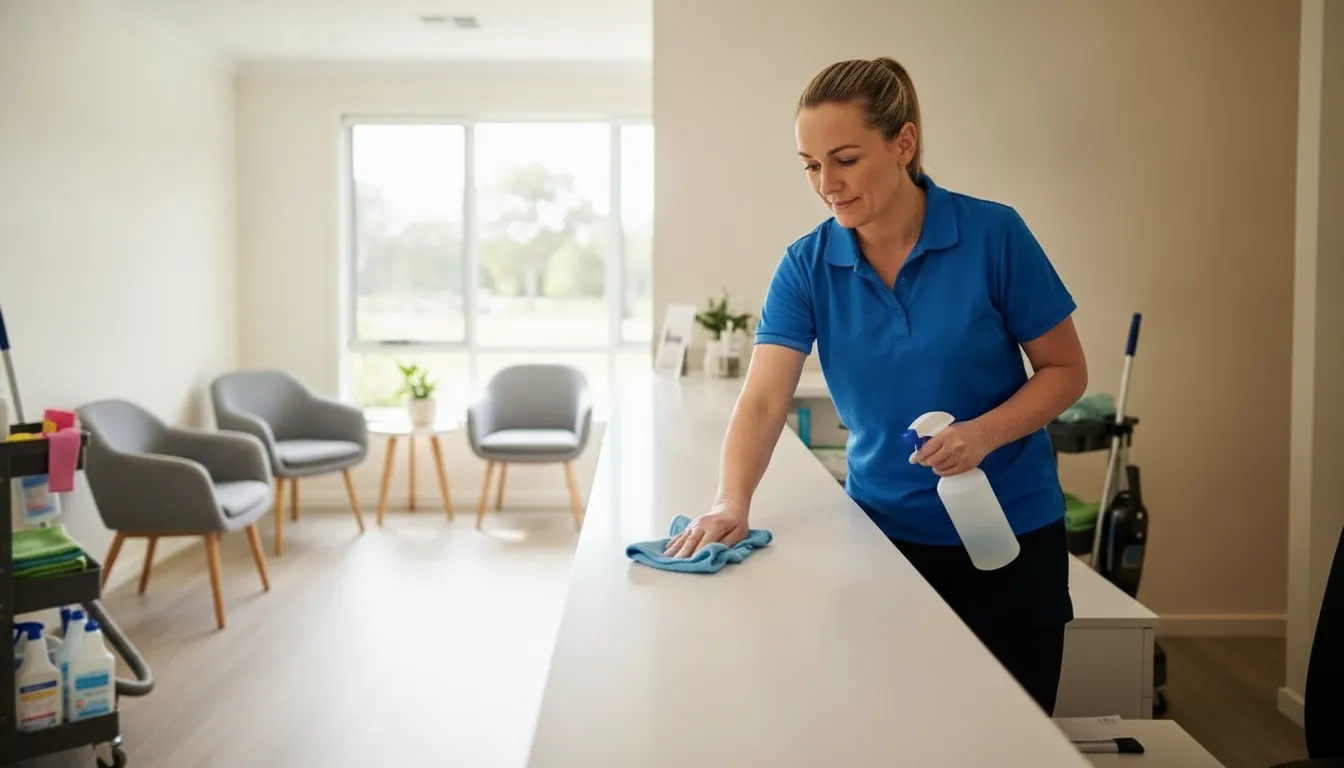
Ask who supplies cleaning products, equipment, liners, restroom paper, and hand soap. Then ask for the product categories and procedures your practice needs to review. General commercial cleaning is not automatically the same as clinical disinfection, infection-control work, or specialty healthcare cleaning. If your office has treatment areas, specialized equipment, or regulated materials, ask qualified advisors and prospective vendors who is responsible for those requirements. Do not assume they are covered by a standard janitorial agreement.
Also clarify exclusions before signing. A responsible office cleaning service for medical offices should be able to state whether it does not handle clinical disinfection. Sharps, regulated waste, blood or other specialized cleanup, equipment sterilization, or tasks requiring credentials it has not verified. Clear exclusions prevent an urgent situation from being mistaken for routine cleaning.
Maid OK offers scheduled office cleaning with frequencies customized to business needs. Its commercial offerings include office cleaning, commercial floor maintenance, restroom cleaning, and janitorial service. Practices in the Oklahoma City metro can review the company's commercial janitorial services, then confirm directly whether the proposed scope fits their facility and any specialty requirements.
Which Operational Questions Should You Ask Before Signing?
A provider can sound polished during a sales call, but the daily details determine whether the arrangement works for a busy practice. Use the questions below during a walkthrough and ask for clear answers in writing. They will also help you distinguish routine office cleaning from any specialized healthcare procedures your practice may need to arrange separately.
- What cleaning frequency fits our traffic and schedule? Ask how the provider would recommend a daily, several-times-per-week, or less frequent schedule based on your operating hours, patient volume, staff areas, and appointment flow. Maid OK offers scheduled office cleaning with frequencies customized to business needs, but any recommendation should be tied to your actual facility rather than a generic package.
- Can the work happen after hours, and how is access handled? Confirm arrival windows, keys, codes, alarm procedures, locked areas, and the process for missed access. If evening or early-morning service is important, ask whether the same schedule can be maintained consistently and who should be contacted when the office closes unexpectedly.
- Will we see the same team regularly? A consistent team can reduce repeated explanations and make it easier to identify unusual conditions. Ask how absences are covered, whether substitutes receive the same instructions, and how staff access and background-check policies are managed. Do not assume consistency or screening practices without verifying them.
- How will we communicate changes or concerns? Identify one accountable contact and ask how to report a missed task, request an extra visit, or change a room's access instructions. Clarify expected response times and whether routine updates are documented. A short escalation path is more useful than a vague promise to provide good service.
- Which supplies and equipment are included? Ask who provides vacuums, floor-care equipment, restroom supplies, liners, and cleaning products. For patient-care areas, ask the prospective provider to identify products and procedures for your clinical or regulatory requirements, and have qualified practice leadership verify that they are appropriate. General office-cleaning experience does not establish clinical disinfection or regulated-waste capability.
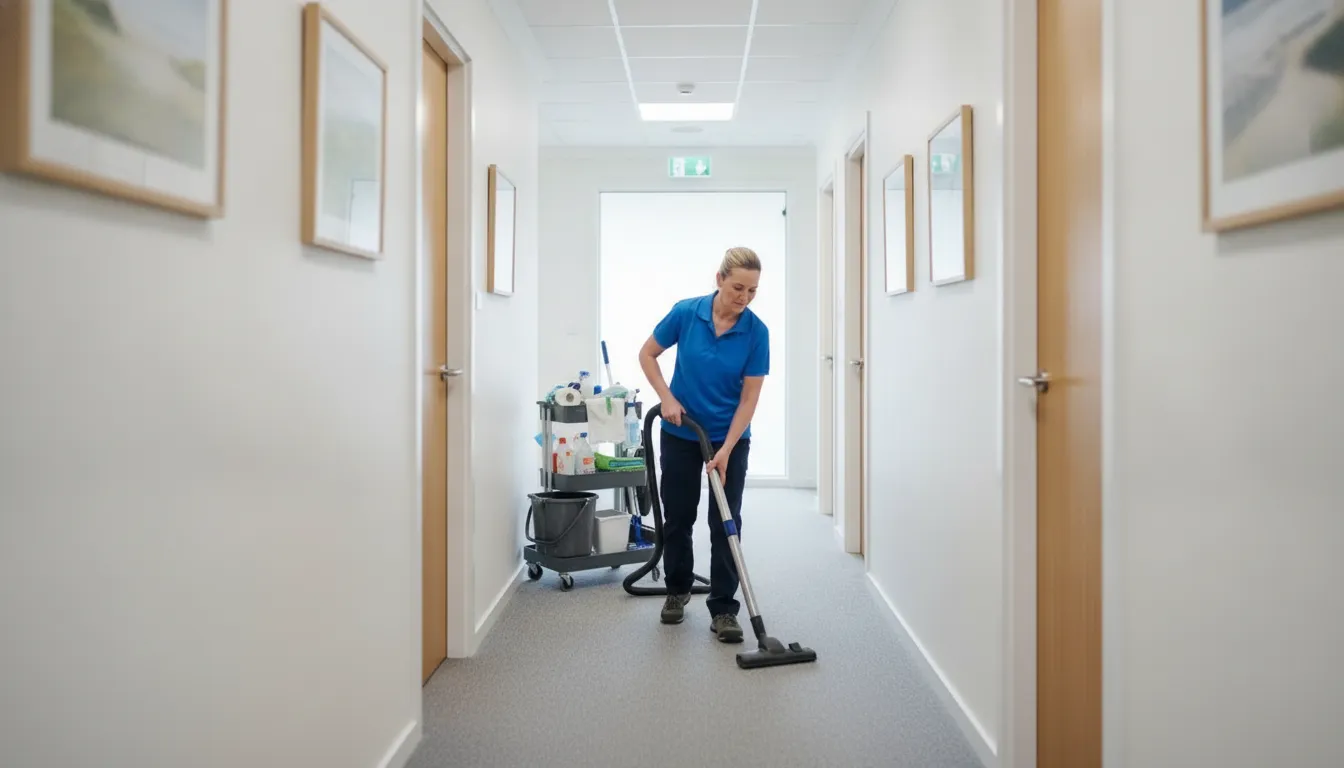
- What happens when our scope changes? Ask how the provider handles a renovated room, seasonal workload, construction dust, an additional restroom, or a request for a one-time deep clean. Confirm whether changes require a new walkthrough, written approval, or a separate work order. This prevents assumptions about what the recurring service includes.
- How are restrooms and floors documented? Ask which surfaces receive attention, how often floor care is performed, and whether restroom tasks are included in every visit or scheduled separately. Use this commercial restroom cleaning checklist and guidance on commercial floor cleaning to make the conversation specific.
- Where is the checklist, and how is completion checked? Request a room-by-room scope that names offices, waiting areas, restrooms, floors, touchpoints, and exclusions. An office cleaning checklist can help you compare proposals, but the final checklist should reflect your practice's layout and approved requirements.
Before signing, compare the answers with the written scope. If a practice needs specialized healthcare procedures, require separate documentation and confirmation rather than treating ordinary commercial service language as proof.
How Do You Verify Safety, Insurance, and Accountability?
A provider's answers should be specific enough for your practice to document and verify. Start by asking whether the company is properly licensed and insured. Then request current proof of coverage and ask what the policy covers if a worker is injured, property is damaged, or an incident occurs on site. Maid OK is described as licensed and insured and offers a 100% satisfaction guarantee at the company level. Those are useful trust signals, but they do not by themselves establish healthcare-cleaning compliance.
Ask how people access the office
Medical practices should ask how cleaners are screened before they receive keys, alarm codes, or access to staff and patient areas. Does the company conduct background checks? How are references or employment history reviewed? Are teams assigned consistently, and who is notified when a regular cleaner is replaced? Ask how access is recorded and how lost keys, codes, or badges are handled. After-hours service and consistent team assignments may reduce disruption, but they are details to confirm with the vendor rather than assumptions to make.
Request product and training details
Ask for product names, safety data sheets, dilution instructions, storage procedures, and guidance for use around patients, staff, equipment, and sensitive surfaces. If your office needs a particular disinfectant, contact time, surface protocol, or specialty procedure, request written documentation that addresses that exact need.
Do not accept broad phrases such as medical-grade as proof. Verify healthcare-specific claims with the vendor and qualified sources, including the appropriate infection-prevention or regulatory authority for your facility. Ask directly about specialty training, clinical disinfection procedures, bloodborne-pathogen exposure, regulated materials, and patient-care areas. This article does not establish that Maid OK provides those specialized services, so a practice should confirm capabilities before adding them to a scope of work.
Define inspection and incident resolution
Ask how completed work is inspected, how missed tasks are documented, and who receives the report. Maid OK uses a 49-point inspection in its quality-assurance positioning, but that inspection should not be treated as a medical-office sanitation protocol. Ask the provider to explain what its inspection covers in your facility and how results are shared.
Finally, agree on an escalation path before service begins. Who should your office call after a missed area, spill, damaged item, access concern, or product issue? What response time applies, and how is the correction confirmed? Clear reporting and resolution procedures let your team address problems quickly without leaving accountability to informal promises.
What Should the Walkthrough and Proposal Spell Out?
A walkthrough should turn general promises into a written scope that your practice can review. Ask the provider to inspect the actual rooms, entrances, restrooms, flooring, high-touch areas, and any scheduling constraints before preparing a proposal. If a company will serve offices roughly 50 miles around Norman, confirm that your location is within its active service area rather than assuming metro coverage applies everywhere.
Bring your current office cleaning checklist to the conversation, then compare each provider's answers against the same questions. A useful proposal should make it clear what happens, when it happens, who is responsible, and what requires a separate agreement.
| Concern | Question to ask | Evidence to request |
|---|---|---|
| Service area | Do you regularly service this address and understand the travel and access requirements? | Written service-area confirmation and the proposed contact path. |
| Schedule | What frequency and service window fit our patient hours, and is after-hours work available? | A recurring schedule showing arrival windows, tasks, and holiday handling. |
| Rooms and surfaces | Which exam rooms, offices, waiting areas, break areas, and touchpoints are included? | A room-by-room scope with cleaning methods and clearly marked exclusions. |
| Floors and restrooms | How will different floor types and restrooms be maintained without disrupting the practice? | Task frequencies, equipment details, and any floor-care limitations. |
| Supplies | Which products and equipment do you provide, and can we review product documentation? | Product list, safety information, and a process for approving substitutions. |
| Exclusions and specialty needs | What is outside the standard scope, and which clinical, infection-control, or regulated-waste tasks require a qualified specialist? | Exclusions in writing, plus the vendor's specific training or credential documentation if offered. |
| Pricing structure | Is the proposal based on rooms, visits, frequency, square footage, tasks, or a combination? | An itemized scope, payment terms, change-order process, and conditions that could alter the charge. |
| Walkthrough and accountability | Who reviews the work, handles missed tasks, and communicates scope changes? | Named contact, inspection or quality-check process, response expectations, and escalation steps. |
For a general commercial program, Maid OK describes scheduled office cleaning with frequencies customized to business needs, along with commercial floor and restroom care. That does not establish medical-office specialization. Ask any provider, including Maid OK, to confirm whether its documented capabilities match your practice's specific requirements before signing.
How Can You Compare Providers Without Choosing on Price Alone?
A low quote can look attractive until missed visits, unclear responsibilities, or inconsistent results create more work for your practice. Compare each provider against the same practical questions, then weigh the answers according to your office's priorities.
Start with fit and verified scope
First, confirm that the provider's routine service actually matches your facility. Ask which rooms, surfaces, restrooms, floors, waiting areas, and staff spaces are included, how often each area is serviced, and what falls outside the agreement. If your practice has patient-care areas or other specialized requirements. Ask the provider to identify what it can support and what must be handled by a qualified specialist or under your facility's own policy. Do not accept broad terms such as medical cleaning without a specific scope in writing.
A useful proposal should also explain who supplies products and equipment, how additions to the scope are approved. And how the schedule changes when your hours or patient volume change. The CDC recommends that service agreements describe schedules, methods, supplies, responsibilities, and monitoring so the facility and contractor share the same expectations. Review the CDC's program guidance when building your questions.
Score reliability and accountability
Next, look beyond promises of dependable service. Ask whether the provider can offer a consistent team, an after-hours schedule that protects your workflow, and a clear backup plan when an assigned cleaner is unavailable. Find out who supervises the work, who receives concerns, and how quickly missed tasks or access problems are addressed. A named contact and a documented escalation path are more useful than a general assurance that someone will call back.
Quality control should be visible. Ask what gets inspected, how often inspections occur, whether results are shared, and how corrections are tracked. A provider that welcomes a walkthrough, records the agreed scope, and explains its feedback process gives you a stronger basis for evaluating performance. Maid OK describes systematic quality checks as part of its service model. But any inspection approach should be confirmed for the specific commercial agreement rather than assumed to be a clinical sanitation protocol.
Use a simple comparison scorecard
Give each provider a rating for scope fit, schedule reliability, documentation, quality control, communication, flexibility, and total value. Total value includes the time your staff spends chasing corrections, not just the monthly price. For broader context on evaluating janitorial services for offices, compare the provider's general offering with the medical-office questions in this guide.
Finally, verify the details before signing: insurance, access policies, product documentation, training claims, exclusions, cancellation terms, and the process for changing service. The strongest choice is the provider whose written scope and operating process fit your practice. Whose claims can be verified, and whose communication gives your team confidence when conditions change.
Contact Maid OK about commercial cleaning needs
Frequently Asked Questions
How should you clean a medical office?
Start by separating routine office areas from patient-care spaces, then define the surfaces, frequency, products, and process for each area. Ask the provider to align the written schedule with your practice's policies and any healthcare-specific requirements. The CDC says cleaning procedures should reflect factors such as contamination risk, patient vulnerability, and whether surfaces are high-touch. CDC guidance can help your team frame that discussion.
What should doctors' offices ask a cleaning company to provide?
Request a detailed scope covering exam rooms, waiting areas, restrooms, floors, high-touch surfaces, supplies, equipment, exclusions, and escalation procedures. Also ask who supervises the work, how staff are trained, how quality is checked, and how missed tasks are reported and resolved. A written service agreement makes expectations easier to verify.
Does a general office cleaner meet every medical-office requirement?
Not necessarily. Medical practices may have specialized patient-area, infection-prevention, product, or regulated-material requirements that ordinary commercial cleaning does not cover. Ask each provider to state exactly what it can and cannot perform, and have your practice's qualified clinical or compliance contacts verify any specialty claims before signing.
How often should a medical office be cleaned?
There is no single schedule for every practice. Frequency should reflect room use, patient flow, surface exposure, contamination risk, and your facility's policies. Ask for a room-by-room schedule that names the responsible team, cleaning method, and frequency, with a process for adjusting service when operating needs change.
What should be included in the cleaning agreement?
Include the service areas, task list, schedule, products and equipment, staffing and backup plans, access procedures, reporting lines, quality reviews, communication contacts, exclusions, and resolution process. The CDC recommends explicitly describing standard program elements in agreements with outside cleaning companies to support accountability.
Ask the provider to confirm these details in writing before the first visit.
Talk With Maid OK About Commercial Cleaning
A clear conversation can help you match your office's rooms, schedule, access needs, and expectations with a practical cleaning plan. Ask questions, share the details that matter to your team, and confirm what the service includes before moving forward.
Need a hand with the actual cleaning? Get a free Maid OK quote.